
Why Natural Stone Makes You Feel Good: The Science of Biophilic Design
The science behind why natural stone makes interiors feel better. Biophilic design research, colour psychology, and what it means for your stone project.
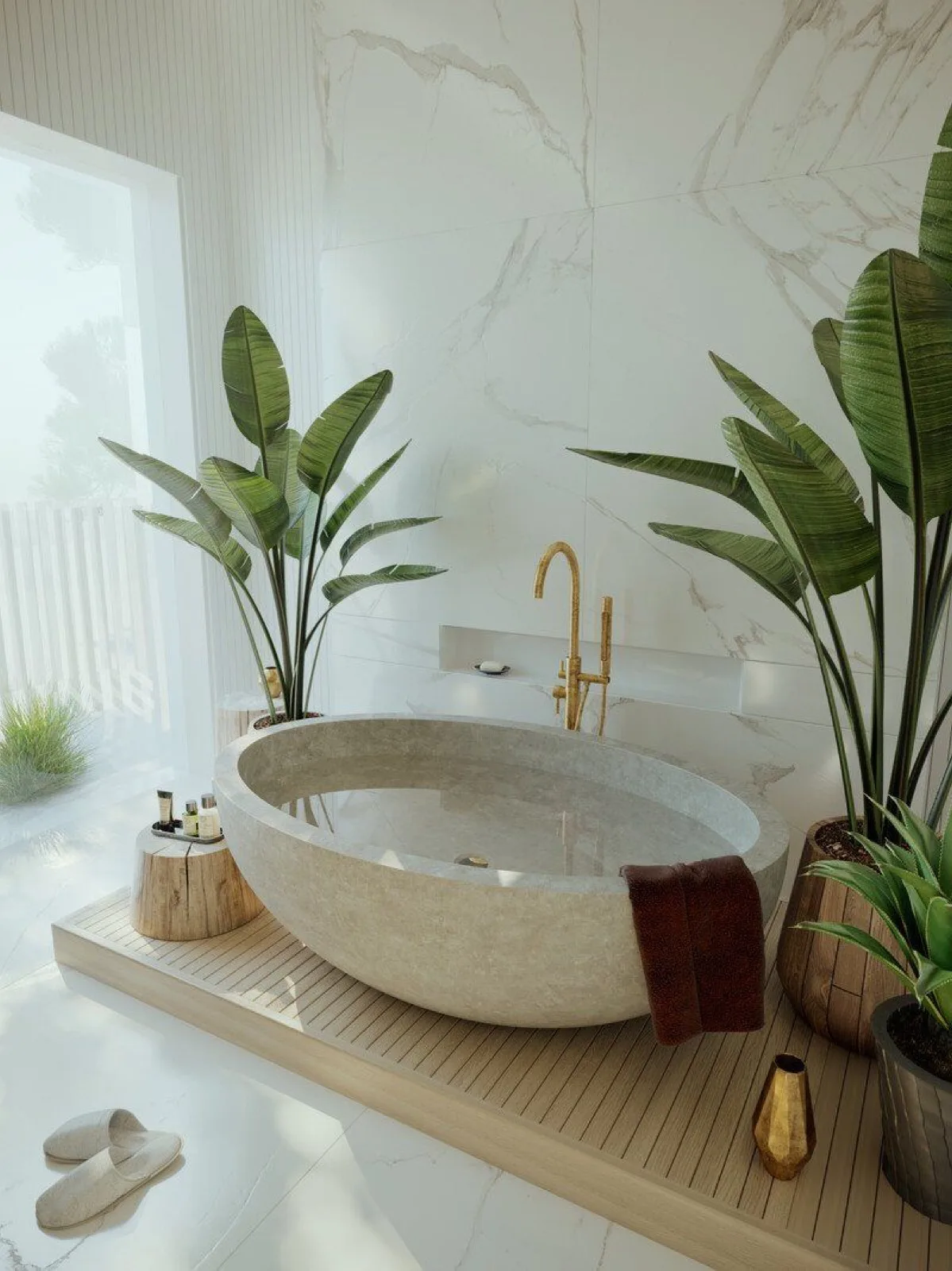
The Instinct You Already Have
You've probably walked into a room and felt something shift — not because of the furniture or the colour on the walls, but because of the materials. A stone fireplace surround that draws your hand before you've thought about it. A slate floor that grounds a space in a way laminate never quite manages. A marble surface whose veining you catch yourself tracing with your eyes.
That response isn't accidental. There's a growing body of research showing that humans respond differently to natural materials than to manufactured ones — and that stone, in particular, triggers psychological and physiological effects that matter more than most people realise.
---
Biophilic Design: The Framework
The word "biophilia" comes from E.O. Wilson's 1984 hypothesis that humans have an innate need to affiliate with other living systems and natural processes. We evolved in natural environments. Our nervous systems are calibrated to respond to natural stimuli — light, water, vegetation, stone, wood, earth — in ways that synthetic environments don't replicate.
Biophilic design takes this hypothesis and applies it to architecture and interiors. In 2014, Terrapin Bright Green published the "14 Patterns of Biophilic Design" — an evidence-based framework that classifies how natural elements can be incorporated into built environments. It was developed through extensive interdisciplinary research and is now widely used by architects, interior designers, health professionals, and developers.
The framework identifies three categories:
Nature in the Space — direct experience of nature: plants, water, natural light, views to the outside.
Natural Analogues — indirect experience through materials, patterns, and forms that reference nature. This is where stone lives. Natural materials, textures, and colours that evoke the natural world without requiring a living element.
Nature of the Space — spatial configurations that create feelings of prospect, refuge, mystery, and exploration.
Stone and natural materials fall primarily under Pattern 8: "Biomorphic Forms and Patterns" and the broader use of natural analogues. The veining in marble, the mineral deposits in granite, the layered sediment in sandstone — these aren't just decorative features. They're the kind of visual complexity that biophilic research identifies as restorative for human cognition and wellbeing.
---
The Evidence: What the Research Actually Shows
This isn't speculation. Published, peer-reviewed research supports measurable impacts.
A controlled study with 255 participants found that biophilic environments significantly reduce stress and boost mood. After stress induction, participants in biophilic settings showed greater recovery, improved mood, and increased feelings of inspiration compared to those in non-biophilic settings. The study was published in a peer-reviewed journal in 2024.
Broader reviews of biophilic design research have associated biophilic environments with approximately 15% increases in productivity and 25% improvements in perceived comfort, alongside measurable stress reduction. The Terrapin Bright Green framework presents the financial potential for deploying biophilic design across offices, communities, schools, retail, and hospitals.
There's a direct link between exposure to nature and natural materials and reduced stress, improved cognitive function, and boosted mood. These aren't marginal effects. In workplace settings, hospitals, and schools, the impact is significant enough to affect outcomes — from patient recovery times to student test scores to employee retention.
---
Why Stone Is Different from Its Imitations
Research indicates that people instinctively prefer real natural materials over synthetic alternatives. Human sensory receptors can detect the difference between natural and manufactured surfaces through touch, visual assessment, and even olfactory cues.
This matters because it separates genuine natural stone from printed, laminated, or moulded alternatives. A porcelain tile printed to look like marble is not the same as marble — not just aesthetically, but in how people respond to it. The eye reads the difference. The hand feels it. The brain processes it differently.
What makes natural stone biophilically effective is its inherent visual complexity. Stone's natural patterns — veining, fossils, mineral variations, colour gradients — create what researchers describe as "organised disorder". Not random chaos, and not mechanical repetition, but the kind of complex patterning that natural systems produce and that human cognition finds restorative.
European Modernist architects understood this intuitively. Mies van der Rohe and Frank Lloyd Wright used the grain of wood and the veining of stone as decorative elements while exploring the relationship between interior and exterior space — an early expression of biophilic principles before the science existed to explain why it worked.
---
The Colour Psychology Connection
The biophilic effect of stone isn't only about texture and pattern. Colour plays a measurable role.
Scientific studies confirm that colour influences people psychologically and physiologically — affecting mood, cognitive function, productivity, spatial perception, and emotional response. The intensity and brightness of a colour significantly impact its effect: high-saturation colours feel bold and stimulating, while muted tones create a more subdued and sophisticated experience.
Natural stone colours — the warm beiges and honeys of sandstone, the cool greys and silvers of granite, the deep greens of serpentine, the blacks and coppers of quartzite — fall naturally into the palette that colour psychology identifies as grounding, calming, and restorative.
Warm earthy tones (beige, brown, terracotta) are associated with comfort, stability, grounding, and connection to nature. Cool tones (grey, blue-green) bring calm and relaxation, visually expanding a space. Critically, research shows that wood and stone in brown tones feel "comfortable and warm" — distinct from brown paint on its own, which in institutional settings can evoke negative associations. The material itself matters, not just the colour.
This has practical implications. A dark stone feature wall doesn't just look dramatic — it adds perceived depth and warmth to a room. Light stone across all walls creates an open, airy feel. The spatial and psychological effects are different, and both are rooted in how colour and material interact with human perception.
---
Stone in Scottish Light
Scotland's light conditions amplify the biophilic qualities of stone in ways that deserve mentioning. The low sun angle across much of the year creates long shadows and raking light that catches stone texture — surface relief, mineral sparkle, colour variation — more dramatically than the overhead light of lower latitudes.
A split-face sandstone wall in a Scottish living room responds differently to December afternoon light than to August midday sun. Both are interesting. Both create the kind of visual dynamism that flat manufactured surfaces simply don't produce.
Scotland's building heritage is, of course, profoundly shaped by stone — from the Lewisian gneiss of the Outer Hebrides to the granite of Aberdeen to the red sandstone of Dumfries. Using stone in a Scottish interior doesn't just deliver biophilic benefits. It connects a modern space to a material tradition that stretches back thousands of years.
Related reading: Scotland's Building Stone: A Complete Guide to Types, History & Where to See Them
Related reading: We Love: Stone in Scottish Contemporary Homes
---
The Design Trend Catching Up
The current direction in interior design is moving toward exactly what biophilic research recommends. The dominant aesthetic for 2025–2026 is a decisive shift away from cool greys, stark whites, and clinical minimalism toward warm natural palettes — earthy tones, textured surfaces, natural materials.
Texture is the defining material trend: fluted limestone, honed and leathered stone finishes, three-dimensional surface treatments replacing flat, uniform surfaces. Matte finishes are overtaking polished across both stone and fixtures, reinforcing a warmer, less clinical aesthetic.
Bathrooms have shifted from functional spaces to personal sanctuaries — 77% of design professionals report that homeowners want hotel-inspired aesthetics. In kitchens, stone is expanding beyond countertops into architectural features: stone-clad cooker hoods, full-height backsplashes, feature walls.
The common thread is "quiet luxury" — high-quality materials and craftsmanship over flashy, attention-seeking design. Spaces that feel expensive because they are, not because they're trying to prove it.
Natural stone ages with grace. The subtle patina that develops over time is considered character and authenticity, not a flaw. In a world that's increasingly disposable, that quality resonates — and biophilic research explains why.
Related reading: We Love: Textured Stone Bathrooms
Related reading: We Love: Stone Kitchen Features Beyond the Countertop
---
What This Means for Your Project
If you're choosing between natural stone and a manufactured alternative for an interior project, the biophilic evidence adds a dimension beyond aesthetics and cost.
Natural stone doesn't just look different. It feels different, it responds to light differently, and the research suggests it affects the people in the space differently — reducing stress, improving mood, increasing feelings of comfort and inspiration. These aren't subjective claims. They're supported by controlled studies and systematic reviews.
This doesn't mean every surface needs to be stone. Biophilic design is about the overall composition — mixing natural materials (stone, wood, natural fibres), natural light, and spatial variety to create environments that work with human psychology rather than against it. A single stone feature wall in the right position can anchor an entire room.
The question isn't whether stone is worth the investment. The question is whether the space you're creating will feel the way you want it to feel — and what the evidence says about how to get there.
Related reading: Stone Veneer vs Render: Which Is Right for Your Project?