
Scotland's Building Stone: A Complete Guide to Types, History & Where to See Them
Scotland's building stones — sandstone, granite, slate — shaped 3 billion years of geology into the cities we know. A complete guide to types, regions, and heritage.
Three Billion Years Under Your Feet
Scotland sits on some of the oldest exposed rock on Earth. The Lewisian gneiss of the northwest Highlands and Outer Hebrides formed between 3.0 and 1.7 billion years ago — Archaean and Paleoproterozoic age, older than most life, older than breathable atmosphere. These rocks were originally part of what is now Canada, carried to Scotland by the closure of the ancient Iapetus Ocean. Counterpart formations still exist in Greenland and Labrador.
The Callanish Standing Stones on the Isle of Lewis are shaped from naturally occurring pieces of this Lewisian gneiss, positioned approximately 5,000 years ago. Every stone in that circle captures geological processes stretching across hundreds of millions of years.
This is where Scotland's building story begins — not with architecture, but with geology. The rock beneath determined the buildings above. Different regions built with whatever stone lay beneath them, and they did so for over 5,000 years. That principle still shapes Scottish places today: you can read the geology of a town from its buildings.
Scotland's geology spans approximately 3 billion years and encompasses all three major rock types — igneous, sedimentary, and metamorphic. This diversity, extracted from over 3,700 quarries across the country, created the "sense of place" that defines Scottish towns and cities — from the red sandstones of Dumfries to the grey granite of Aberdeen.
---
Sandstone: Scotland's Foundation Stone
Sandstone is Scotland's most widely used building stone. It is a sedimentary rock composed primarily of quartz grains, cemented by minerals such as silica, iron oxide, or calcium carbonate. The cementing agent determines both colour and durability — iron oxide cement produces the reds and browns; silica cement produces lighter, more durable stone.
At their peak in the 19th century, approximately 2,500 building stone quarries operated across Scotland. Today, 14 sandstone quarries remain active, only 4 of which are in continuous operation, producing an estimated 25,000–30,000 tonnes annually. The contrast tells its own story about what happened to the industry — a subject we'll return to.
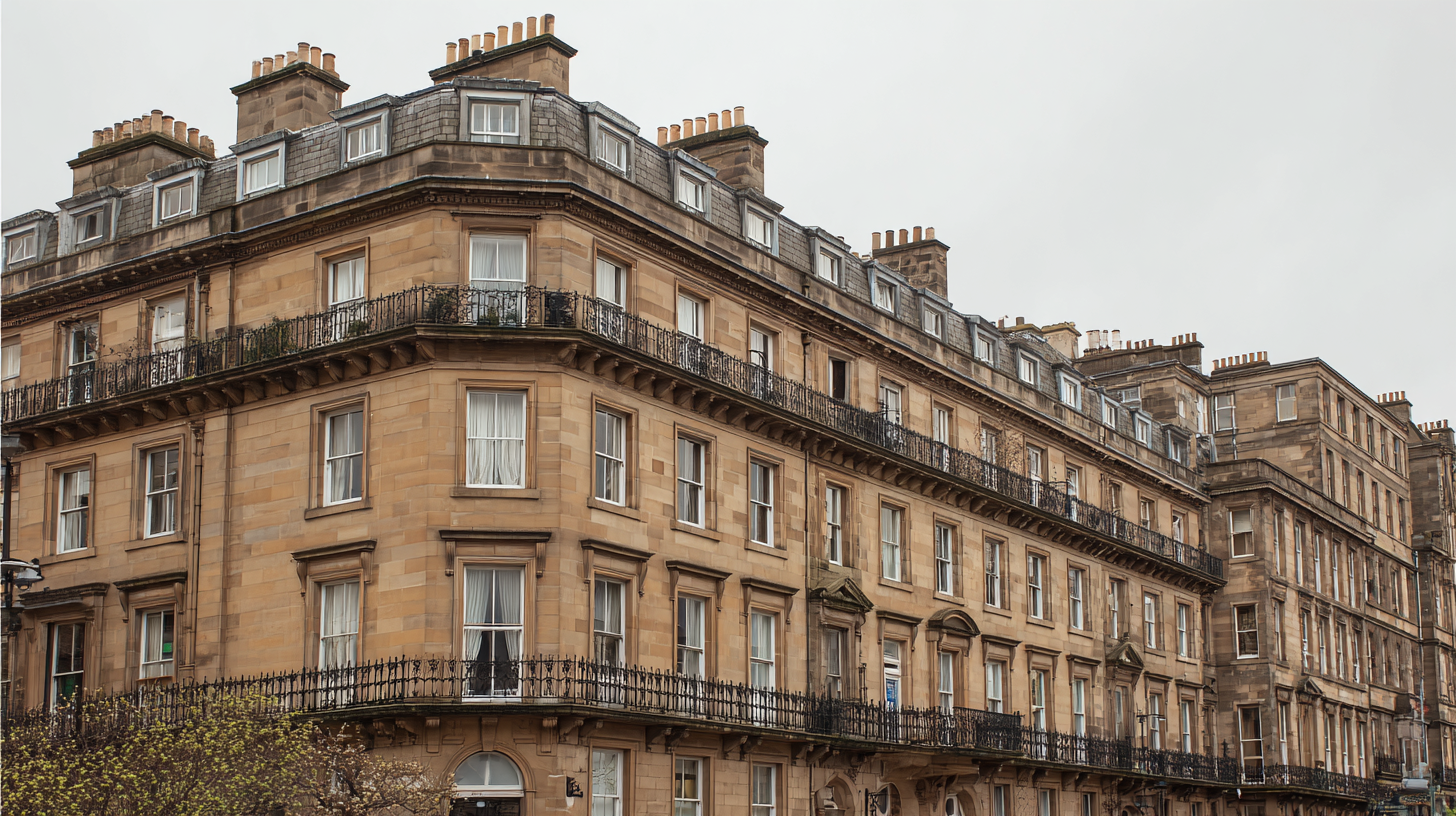
Scottish sandstones range widely in colour — white, buff, brown, orange, red, grey, and pink — depending on their geological origin. This variety means Scottish sandstone buildings are never uniform. The pale golden tenements of Glasgow's West End look nothing like the deep red buildings of Dumfries, and both are entirely different from the grey laminated stone of Angus. All are sandstone. All are Scottish.
Edinburgh: The Sandstone Capital
Edinburgh sits within the Midland Valley of Scotland — an ancient rift valley bounded by the Highland Boundary Fault and the Southern Upland Fault. This basin formed during the Devonian and Carboniferous periods (approximately 410–280 million years ago) and became the focus for sedimentation that produced Scotland's principal building sandstones.
The New Town was built from Craigleith sandstone — a golden Carboniferous sandstone quarried from what is now a retail park on the western edge of the city. The National Museum of Scotland is clad in warm Moray sandstone from the Clashach quarry near Hopeman.
Edinburgh's sandstones were quarried from the Lothians, Fife, Angus, and as far as northern England. The city is a geological anthology, its buildings drawn from formations spanning millions of years and hundreds of miles.
Glasgow: The Blonde City
Glasgow's tenements give the city its visual identity — long terraces of pale buff to golden blonde Carboniferous sandstone. The University of Glasgow is built from the same geological formation. Where Edinburgh's stone tends toward golden and cream, Glasgow's leans warmer and more honeyed, though both come from Carboniferous-age deposits in the Midland Valley.
Dumfries: Red Stone Country
The Permian red sandstones of the Dumfries and Lochmaben basins are among Scotland's most visually striking building materials. Locharbriggs Quarry has been operating since the 18th century and remains one of the oldest and largest actively worked red sandstone quarries in Scotland.
Locharbriggs sandstone is medium-grained, consisting of well-sorted quartz grains coated with iron oxide (giving its distinctive red colour) and cemented by silica. During peak production around 1900, the quarry employed about 260 men.
This stone travelled far beyond Dumfries. Locharbriggs sandstone was used for the Caledonian Hotel in Edinburgh (1899–1903) and exported for the construction of the steps of the Statue of Liberty in New York.
Angus and Tayside: The Old Red Sandstone
The underlying rock in Angus is predominantly Old Red Sandstone, formed during the Devonian period approximately 400 million years ago. You can see it in natural form along the coast between Arbroath and Auchmithie, where red sandstone cliffs drop into the North Sea.
Stone quarried from the beach at Seaton Cliffs was used to build Arbroath Abbey, founded in 1178. After the Scottish Reformation, stones from the abbey were removed and reused to build new buildings around the town — a cycle of use, decay, and reuse that characterises Scotland's relationship with its stone.
The flaggy sandstones of the Dundee Formation were extensively worked at Carmyllie quarries, near Arbroath. This stone built the paving and steps of Edinburgh's New College & Assembly Hall, the Bank of Scotland on the Mound, and Register House. It was also used for the engineering work on the piers of the Forth Railway Bridge in 1885, on account of its strength characteristics.
At peak production, around 150 tonnes of Angus sandstone were being sent to harbours every day. Railways were built from the quarries to Arbroath Harbour specifically to access shipping routes. This stone reached the Vatican, Cologne Cathedral, and projects across South America, North America, Asia, Europe, and Australia.
Today, Pitairlie Quarry in Monikie — reopened in 2004 by Denfind Stone — is the sole source of Angus sandstone in the world. The quarry originally ceased production in 1915.
Related reading: We Love: The Angus Stone Story — From Arbroath Abbey to Modern Craft
---
Granite: The Stone That Built Aberdeen
Scotland has a large number of granite intrusions, with the principal producing areas historically concentrated in Aberdeenshire, Kirkcudbrightshire (southwest Scotland), and the Ross of Mull.
Granite is an intrusive igneous rock, formed by the slow cooling of magma deep within the Earth's crust. Its interlocking crystal structure of quartz, feldspar, and mica gives it exceptional hardness, load-bearing capacity, and weather resistance. If sandstone is Scotland's most widely used building stone, granite is its most durable.
Aberdeen: The Granite City
Aberdeen earned its epithet through the extensive use of locally quarried grey granite. The stone contains high mica content that sparkles in sunlight — giving Aberdeen its other name, the "Silver City". At the peak of the granite industry, there were approximately 150 granite quarries in the Aberdeen area.
Rubislaw Quarry — opened in 1740, closed in 1971 — was one of the biggest man-made holes in Europe: approximately 142 metres deep and 120 metres in diameter. An estimated six million tonnes of granite were extracted over approximately 200 years.
Aberdeen granite was exported worldwide: the terraces of the Houses of Parliament, Waterloo Bridge in London, Bell Rock Lighthouse, the Paris Opera House, and the State Capitol Building in Austin, Texas. By the 1960s, the industry had declined as glass, steel, and concrete became the default construction materials. Rubislaw was the last quarry in Aberdeen to close.
The Range of Scottish Granite
Scottish granite is not a single material. Each quarry produced stone with distinct character:
Rubislaw (Aberdeen city) — silver grey with muscovite-biotite mica. Built most of Victorian Aberdeen and contributed to the Houses of Parliament.
Peterhead Red (Peterhead, Aberdeenshire) — deep red granite used for the pillars of St John's College Chapel in Cambridge and St George's Hall in Liverpool.
Peterhead Blue (Peterhead) — dark blue-grey, used for the Trafalgar Square fountain bases and Prince Albert's Mausoleum.
Kemnay (Aberdeenshire) — light grey speckled, favoured for fine-dressed work and statuary.
Corrennie (Donside, Aberdeenshire) — salmon pink, used for Glasgow City Chambers and the Tay Railway Bridge.
Dalbeattie / Criffel (Galloway, southwest Scotland) — grey granite used for Liverpool Docks and the Thames Embankment.
Very few granite quarries remain active in Scotland today. Most granite used in the country is now imported. Active quarries at Kemnay and Corrennie mainly produce crushed aggregate, with dimensional building stone available only occasionally — typically for prestige public projects such as the Scottish Parliament building.
Related reading: We Love: Aberdeen — The Granite City
---
Slate, Greywacke, and the Rest
Slate
For hundreds of years, slate was Scotland's preferred roofing material. Geological variation across quarries meant each produced slate with characteristic colour, texture, and thickness. Scottish slates were quarried primarily from the Highlands — from the Dalradian metamorphic rocks. Easdale Island in Argyllshire produced typical dark grey slate.
Despite a long quarrying history and suitable geological resources, there are no currently operational Scottish slate quarries. Scotland has no current domestic source of roofing slate — and roofing slate imports command the highest price of all imported stone.
Other Building Stones
Greywacke — a hard, dark grey rock used in buildings across the south of Scotland and the Borders. It owes its hardness to low-grade metamorphism and can be durable, but fractures irregularly.
Basalt and dolerite — volcanic in origin, used in rubble walling where locally abundant, especially around Edinburgh. Also used extensively for road setts (cobblestones).
Scottish marble — quarried on a small scale for ornamental and decorative purposes. The term "marble" was used by quarrymen to describe limestones that could take a polish.
---
How Stone Weathers in Scotland
Scotland's climate poses specific challenges for stone: freeze-thaw cycles, wind-driven rain, moisture fluctuations, biological growth, and in urban areas, pollution.
Freeze-thaw damage is the most significant threat. Water penetrates porous stone, freezes and expands, causing cracks, spalling, and weakening. Scotland's temperature fluctuations — sometimes mild to freezing within a single day — make this particularly relevant. Softer sandstones decay faster than harder sandstones, and both decay faster than granite.
Scotland's climate varies dramatically by location. Coastal Angus faces different exposure from sheltered Perth. Highland conditions differ from the Central Belt. East coast exposure is different from the west. The weathering pattern of a sandstone tenement in Glasgow is not the same as a sandstone church in Montrose — even if the stone came from the same formation.
Aged masonry surfaces develop a natural patina over many years — considered valuable because it adds a sense of history, protects the stone from further weathering, and may enhance appearance. Many stone cleaning techniques once popular have since been proven damaging, particularly to sandstone: cleaning can destroy this protective patina and, in the worst cases, has accelerated natural decay by 6 to 10 times.
Related reading: What Scottish Stone Teaches Us About Choosing Veneer That Lasts
---
Traditional Building with Stone
Breathable Construction
Traditional Scottish buildings (pre-1919) are of "breathable construction" — the materials can absorb and release moisture. They use permeable materials such as stone and lime mortars. Problems such as damp, mould, and dry rot result when moisture is trapped in the building fabric — which happens when modern impermeable materials (concrete, cement) are used inappropriately in repairs.
Traditional buildings account for 19% of Scotland's building stock. Research indicates that 75% of traditional buildings show disrepair and 53% show urgent disrepair.
Dry Stone Dykes
Drystone walling was Scotland's first type of stone construction — stones placed on top of each other with no mortar. Some of the earliest examples in the Northern Isles are approximately 2,000 years old.
Scotland's dry stone walls show regional variations reflecting their geological landscapes. The "double dyke" style predominates in central Scotland — two faces filled with hearting and fortified with throughstones, often crafted from durable whinstone. In southern and western regions, sandstone versions adapt the style.
Harling
Scottish vernacular architecture features a thick coat of harl on exterior walls to protect against frost penetration — usually lime, grit, and water. In coastal areas, sea sand and seashells were incorporated. Regional variations include black harl (using oil from the seashore in Cramond) and red harl (using powdered local sandstone in Portsoy).
Related reading: The Decline and Revival of Scottish Stone: Why It Matters for Building Today
---
The State of the Industry Today
The numbers are stark. The Scottish stone industry currently produces roughly one-tenth of the stone used in Scotland annually. Approximately 160 people are employed in the building stone industry. Over 5 million tonnes of building stone are imported into the UK each year, and the cost of imported stone has almost doubled since 2015.
The British Geological Survey's Building Stones Database for Scotland records approximately 200 building stones, 3,500 quarries, 800 built sites, and 1,000 samples — a catalogue of what once existed, and what could exist again.
A joint BGS and Historic Environment Scotland report published in November 2024 concluded that Scotland is "more than capable of being self-sufficient" regarding building stone requirements. The report identified 139 disused building stone quarries and 31 quarries currently supplying only crushed aggregate that could potentially supply a significant proportion of Scotland's building stone needs.
The barriers are knowledge and skills. The indigenous building stone industry has been near-absent for much of the past century, leading to a decline in people who can operate quarries and work traditional stone. The use of inappropriate materials in repairs has, in some cases, accelerated the very decay it was meant to prevent.
A renewed Scottish building stone market would create rural skilled jobs, reduce carbon emissions (less imported stone), and improve conservation outcomes for historic buildings. The question is not whether Scotland has the stone — it demonstrably does. The question is whether there's the will and the investment to reconnect with it.
---
Where to See Scottish Building Stone
You don't need to visit a museum to see Scotland's stone heritage. You just need to look at the buildings around you.
Edinburgh — Walk the New Town for Craigleith sandstone. Visit the National Museum of Scotland for Moray sandstone. The Old Town uses a mix of Carboniferous sandstones and volcanic rock.
Glasgow — The tenements of the West End are a course in blonde Carboniferous sandstone. The University of Glasgow and Kelvingrove Art Gallery show the stone at its most ambitious.
Aberdeen — The entire city centre is a granite exhibition. Union Street, Marischal College (the world's second-largest granite building), the Music Hall, and the terraces of the West End.
Dumfries — Red Permian sandstone everywhere. The Midsteeple, the town bridges, and the domestic architecture of the town centre.
Angus — Arbroath Abbey (founded 1178, built from local red sandstone). The Arbroath coastal cliffs show the same stone in its natural state. Dundee's older buildings use local Old Red Sandstone.
Caithness and Orkney — Devonian flagstone country. The traditional fences and paving of Caithness, and the Neolithic settlements of Orkney (Skara Brae), are built from the same geological formation.
Moray — Clashach quarry near Hopeman is still working, producing durable siliceous sandstone in white, red, brown, and variegated colours.
Stone wasn't hauled great distances before the Industrial Age. Even small towns and villages had their own quarries. This is why the look of local areas above ground directly reflects the geology below — a principle that, even today, makes Scotland readable to anyone who knows what they're looking at.
---
What This Means for Building Today
Understanding Scotland's stone heritage isn't just history. It informs modern building decisions.
When you choose stone veneer for a Scottish project, you're participating in a tradition that stretches back 5,000 years — from the standing stones of Callanish to the tenements of Glasgow. The materials have evolved (modern ultra-thin stone veneer is a long way from a hand-dressed ashlar block), but the principle is the same: stone endures. It weathers gracefully. It connects a building to its landscape.
Scotland's geology also teaches practical lessons about durability. The stones that survived centuries of Scottish weather — the hard sandstones, the granites, the well-cemented quartzites — share characteristics that matter when choosing modern veneer: density, low porosity, frost resistance, UV stability. The geology that built Scotland can inform the veneer that protects it.
Related reading: Stone Veneer vs Render: Which Is Right for Your Project?