
We Love: The Angus Stone Story — From Arbroath Abbey to Modern Craft
From Arbroath Abbey to the Vatican — the story of Angus sandstone, Carmyllie quarries, and why this corner of Scotland shaped stone building worldwide.
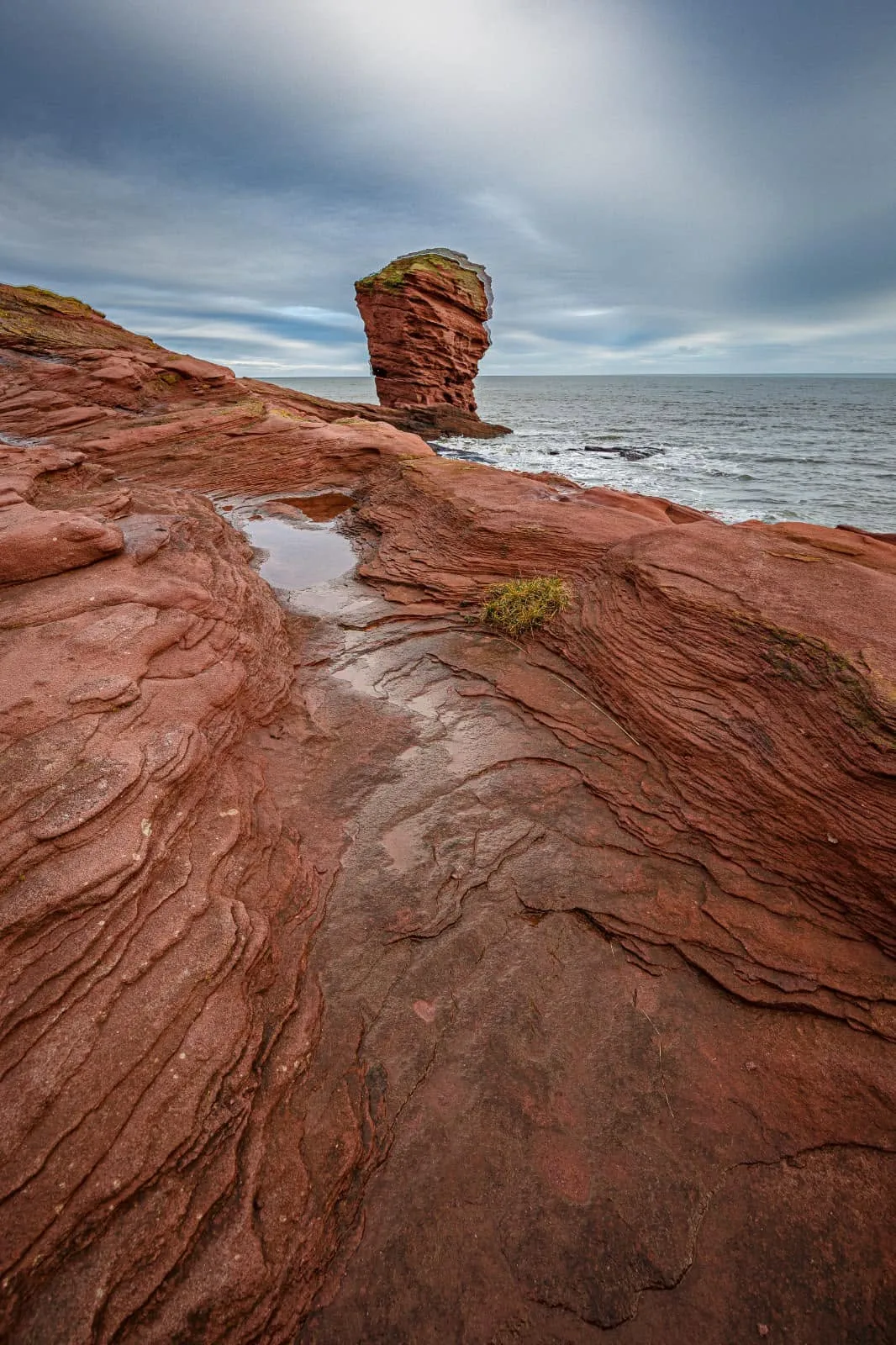
The Stone Beneath Our Feet
If you have walked the coast between Arbroath and Auchmithie, you have seen Angus sandstone in its raw state. Red cliffs, layered and laminated, carved by the sea into arches and stacks. Four hundred million years old. Old Red Sandstone, formed during the Devonian period, when Scotland sat south of the equator and rivers deposited sand across a vast floodplain that became the rock we build with today.
This is our home territory. Masowa & Son is based in Angus. We work with stone every day. And knowing where it comes from — not just which quarry, but how the geology shaped it — changes how you think about the material in your hands.
The Abbey and the Beach
Stone quarried from the beach at Seaton Cliffs was used to build Arbroath Abbey, founded in 1178. For over eight hundred years, that abbey has stood — roofless now, but still standing — built from the same red sandstone that makes up the cliffs behind it.
After the Scottish Reformation in the sixteenth century, stones were removed from the abbey and reused to build the town around it. So when you walk through Arbroath, you are walking through repurposed medieval stonework. The abbey is in the houses. The houses are in the abbey. That is what stone does — it outlasts the purpose you give it.
Carmyllie: When Angus Stone Went Global
The flaggy sandstones of the Dundee Formation were extensively quarried at Carmyllie, a few miles inland from Arbroath. This was no local operation. Carmyllie stone was used for the paving and steps of Edinburgh's New College and Assembly Hall (1845–50), the Bank of Scotland on the Mound (1864–70), and Register House (1774–1834).
But the engineers wanted it too. Carmyllie stone was used in the piers of the Forth Railway Bridge in 1885, chosen for its strength characteristics.
At peak production, Angus quarries were sending around 150 tons of sandstone to harbours every day. Railways were built specifically from the quarries to Arbroath Harbour to reach the shipping routes. The stone went to the Vatican. To Cologne Cathedral. To projects in South America, North America, Asia, and Australia. For a time, this quiet corner of eastern Scotland was exporting its geology to the world.
The Silence, Then the Revival
Then it stopped. The quarries closed. By 1915, the major Angus quarry operations had ceased as concrete, brick, and imported materials took over. For most of the twentieth century, the Scottish stone industry shrank to nearly nothing. The industry currently produces roughly one-tenth of the stone used in Scotland annually.
But Angus sandstone did not disappear. In 2004, Pitairlie Quarry in Monikie — near Dundee — reopened under Denfind Stone. It is currently the sole source and producer of Angus sandstone in the world. The stone is grey, laminated, with a flaggy texture and low permeability. Not suitable as structural building stone, but used for non-load-bearing cladding and ideal for dry stone dyking. Denfind Stone describe their product as "400 million years in the making, evolved through 300 years of innovative quarrying and processing".
Pitairlie sandstone was used for the Dundee Flood Wall along the River Tay — modern infrastructure built from the same geological formation that the medieval masons quarried on the coast.
Why This Matters to Us
Masowa & Son has been working with stone in Angus for twenty years. Andrzej started the business — came to Scotland, learned the local ways, built walls, built a reputation. Now it is father and son, Daniel leading a team of eight craftsmen.
We do not quarry stone. We are not Denfind, and this is not a claim to their heritage. But when you work with stone in Angus — building walls, restoring old work, constructing fireplaces, laying dykes — you are working within a tradition that goes back to those Seaton Cliff quarrymen who cut stone for the abbey. The geology shapes the craft. The craft shapes the place.
In our experience, every area has its stone character. Coastal Angus takes more weather punishment than sheltered inland sites. The east-facing walls need different consideration than a sheltered garden in Perth. This is not textbook knowledge — it comes from twenty years of building in this landscape and seeing what lasts.
The Stone Still Speaks
What we love about the Angus stone story is its continuity. The cliffs at Auchmithie are still there. The abbey is still there. The geological formation that produced both is still underfoot. And at Pitairlie, the stone is still being cut.
Scotland built itself from what lay beneath it. Each town, each village, each stretch of coastline had its own quarry and its own stone character. This is why Arbroath looks different from Dundee, and Dundee looks different from Aberdeen, and Aberdeen looks different from Edinburgh. The geology created a "sense of place" — a phrase the British Geological Survey uses to describe why Scotland's built heritage feels connected to the landscape in a way that modern construction often does not.
That sense of place is worth protecting. It is worth understanding. And if you are building or renovating in Angus — or anywhere in Scotland — it is worth knowing what came before.
Related reading: Scotland's Building Stone: A Complete Guide to Types, History & Where to See Them
Related reading: The Decline and Revival of Scottish Stone: Why It Matters for Building Today