
Stone Veneer vs Brick Slips: What Matters for Your Project
Stone veneer or brick slips for your project? Compare cost, weight, durability, fire rating and climate performance. UK-wide supply from Arbroath.
Quick Answer
Stone veneer and brick slips solve the same fundamental problem: they give you the appearance of traditional masonry construction without the structural requirements, cost, or build time of full-depth stonework or brickwork. They're the two products most often compared at the specification stage — and they're more different than they look.
Brick slips offer uniformity, a geometric aesthetic, and a price point that works for large-area exterior applications. Stone veneer offers textural depth, natural colour that won't fade, and — depending on the product — dramatic weight advantages that open up substrates brick slips can't reach.
The right choice depends on your project, your substrate, your aesthetic, and your performance requirements. This guide compares them honestly, with Scotland-specific data where it exists.
---
What We're Actually Comparing
Brick Slips
Brick slips are thin sections of brick — typically 15–25mm thick — designed to give the appearance of a brick wall without the need for full bricklaying. They can be genuine kiln-fired clay (cut from full bricks or manufactured at slip thickness) or cement-based replicas.
They're fixed to walls using adhesive, mechanical fixings, or proprietary tracking systems, and the joints are pointed to match traditional brickwork. A well-installed brick slip wall is difficult to distinguish from the real thing — which is the point.
Brick slips typically cost £35–£100 per m² for materials, with installed costs ranging from £70–£100 per m². Weight varies by thickness and material but generally falls between 25–45 kg/m².
Stone Veneer
Stone veneer covers a wider range of products — from thick-cut natural stone (12–30mm, 30–50 kg/m²) to ultra-thin natural stone (1–3mm, 1.5–2 kg/m²). For this comparison, we're treating it as a category, with distinctions noted where they change the comparison.
Natural stone veneer material costs typically range from £30–£70 per m², with installed costs from £50–£150 per m². The range is wider than brick slips because the product category is wider.
Related reading: Types of Stone Veneer Explained: Natural vs Manufactured vs Ultra-Thin
---
The Comparison: Eight Factors
1. Aesthetic and Character
This is where the decision starts for most projects — because specification follows design intent.
Brick slips produce a geometric, coursed appearance. Uniform heights, consistent colour (especially manufactured slips), regular mortar joints. The visual language is orderly, urban, familiar. It works in residential developments, commercial frontages, apartment buildings, and anywhere the design calls for a contemporary or traditional brick finish.
Stone veneer produces a more varied, textured appearance. Natural colour variation across each piece, three-dimensional surface depth (especially split-face products), and an organic visual rhythm that changes with the light. Stone reads differently from brick — warmer in some applications, more dramatic in others. For a sense of what's possible with interior feature walls or commercial spaces, the range of textures and colours in natural stone opens design options that brick's geometry can't match.
Neither is objectively better. But they create fundamentally different atmospheres. A development of brick-slip terraces will look contemporary and uniform. A building with natural stone veneer will look textured and singular. In a Scottish context — where stone is the traditional building material across much of the country — stone veneer carries an architectural resonance that brick slips don't.
The Scotland factor: Scotland's built environment is predominantly stone, not brick. Aberdeen is granite. Edinburgh is sandstone. Angus, Perthshire, Fife, the Borders — all stone-built regions. While brick has its place (particularly in newer housing estates and industrial buildings), stone veneer connects more naturally to Scotland's architectural character.
2. Weight and Substrate Requirements
This is where the comparison gets technical — and where the product sub-categories within stone veneer matter significantly.
Brick slips: 25–45 kg/m² typically. Require a stable, load-bearing substrate — concrete block, brick, render board, or structural SIPs panels. Most brick slip manufacturers recommend against application to plasterboard or lightweight timber framing without additional support.
Thick-cut natural stone veneer: 30–50 kg/m². Similar substrate requirements to brick slips. Load-bearing walls, structural consideration needed.
Ultra-thin natural stone veneer: 1.5–2 kg/m². This is where the comparison shifts. At these weights, stone can go on plasterboard, timber framing, lightweight steel, and substrates that would never support brick slips or thick-cut stone. For retrofit projects, interior applications, and lightweight construction — including timber-frame buildings, which make up a growing proportion of Scottish new builds — ultra-thin stone is in a category that brick slips simply cannot match.
For builders: If you're specifying for a timber-frame new build or a retrofit project where substrate reinforcement isn't practical, ultra-thin stone veneer gives you a natural material option that brick slips can't offer at any price point. View the full product range to see what's available for lightweight substrates.
3. Cost
Cost comparisons need to include materials, installation, and — for an honest assessment — lifecycle costs over 25 years.
| Factor | Brick Slips | Stone Veneer (thick-cut) | Stone Veneer (ultra-thin) |
|--------|------------|---------------------------|----------------------------|
| Material (£/m²) | £35–£100 | £30–£70 | Contact for pricing |
| Installed (£/m²) | £70–£100 | £50–£150 | Contact for pricing |
| Maintenance | Low — periodic repointing if exposed | Low — periodic inspection, optional sealing | Low |
| Typical lifespan | 30–50+ years | 30–50+ years | Contact for details |
Sources: MyBuilder, Devis Architecture, Real Brick Cladding, Real Stone Cladding, Homebuilding & Renovating — UK data, accessed 2026.
On initial cost, brick slips and thick-cut stone veneer occupy a similar range. Ultra-thin stone pricing is not included here as it requires confirmation — but the installed cost comparison should factor in the labour difference: ultra-thin stone's large panel formats (up to 305×122cm) can reduce installation time compared to both brick slips and thick-cut stone, which are applied piece by piece.
The hidden cost comparison: If your substrate can't support brick slips or thick-cut stone without reinforcement, the cost of structural preparation needs adding to the installed price. For timber-frame or plasterboard applications, that preparation cost can exceed the cladding material cost — making ultra-thin stone cheaper overall despite potentially higher material unit pricing.
4. Fire Performance
Fire classification is not optional on commercial projects and is increasingly scrutinised on all new builds following the regulatory changes since 2018.
Natural stone — both thick-cut and ultra-thin varieties made from genuine quarried stone — achieves A1 classification under BS EN 13501-1: completely non-combustible, the highest fire rating available.
Brick slips — kiln-fired clay brick slips also achieve A1 classification. Cement-based replica slips may achieve A1 or A2 depending on composition.
Scottish Building Standards require A1 or A2-rated external cladding on any relevant building with a storey above 11m. Both genuine stone veneer and kiln-fired clay brick slips meet this requirement. However, the adhesive systems and backing boards also contribute to the overall system classification — specifying the surface material alone is not sufficient for Building Control compliance.
For buildings under 11m (which covers most residential projects in Scotland), both materials exceed the minimum fire requirements. But even here, A1 classification provides a useful selling point for builders talking to clients who are — understandably — more aware of cladding fire safety than they were a decade ago.
Related reading: Stone Veneer Fire Ratings Explained
---
Summary so far: On aesthetic, stone offers more texture and variety; brick slips offer geometric uniformity. On weight, ultra-thin stone wins decisively for lightweight substrates. On cost, they're comparable for standard substrates — but ultra-thin stone can be cheaper overall when structural preparation is factored in. On fire, both natural stone and kiln-fired brick slips achieve A1. The next four factors address long-term performance.
---
5. Durability in Scottish Conditions
Scotland's climate is the test. Freeze-thaw cycling, wind-driven rain, extended damp periods, coastal salt exposure in many areas, and UV exposure that varies dramatically by season and orientation.
Brick slips: Kiln-fired clay is inherently frost-resistant — it's been tested by centuries of Scottish weather on full-depth brickwork. The vulnerability lies in the adhesion and the pointing. If the adhesive bond fails or pointing deteriorates, moisture can penetrate behind the slips, leading to frost damage, efflorescence, and eventually slip detachment. Correct specification of adhesive (freeze-thaw rated, S2 polymer-modified for external use) and pointing material is essential.
Natural stone veneer: Natural stone is geologically frost-resistant — Scotland's own building stone has survived centuries of its own climate. The same adhesion and fixing considerations apply: the stone will outlast the fixing if the fixing isn't specified correctly. Stone veneer requires appropriate adhesive for the weight, exposure, and substrate, and exterior applications benefit from breathable sealant to reduce moisture penetration without trapping vapour behind the stone.
Neither material has an inherent durability advantage over the other in Scottish conditions. Both will perform for decades if specified and installed correctly. Both will fail prematurely if the adhesive, substrate preparation, or pointing is inadequate. The honest answer is that installation quality matters more than material choice for Scottish durability.
6. Installation
Brick slips: Applied individually, piece by piece, with adhesive. Each slip is positioned, levelled, and spaced. Joints are then filled and tooled. Corners require pre-formed corner slips or mitred cuts. A skilled installer can cover approximately 3–5 m² per day depending on format and complexity.
Thick-cut stone veneer: Similar piece-by-piece application. Heavier individual pieces may slow installation slightly compared to brick slips. Corner and reveal details require cutting. Coverage rates are similar to brick slips.
Ultra-thin stone veneer: Large-format panels (up to 305×122cm) cover significantly more area per unit. The lightweight nature reduces handling difficulty. Installation speed can be substantially faster than brick slips or thick-cut stone — though exact comparative rates depend on the specific product and application.
For builders pricing a project: Installation time is labour cost. If you're comparing quotes, check whether the cladding price includes labour and what coverage rate the installer is working to. A material that costs more per m² but installs in half the time may be cheaper overall.
7. Design Flexibility
Brick slips offer colour range (whites, yellows, reds, browns, greys, blacks), bond patterns (stretcher, flemish, stack, herringbone), and mortar colour options. But the fundamental visual language is brick — rectangular units in a coursed pattern. Departing from that language means you're working against the material.
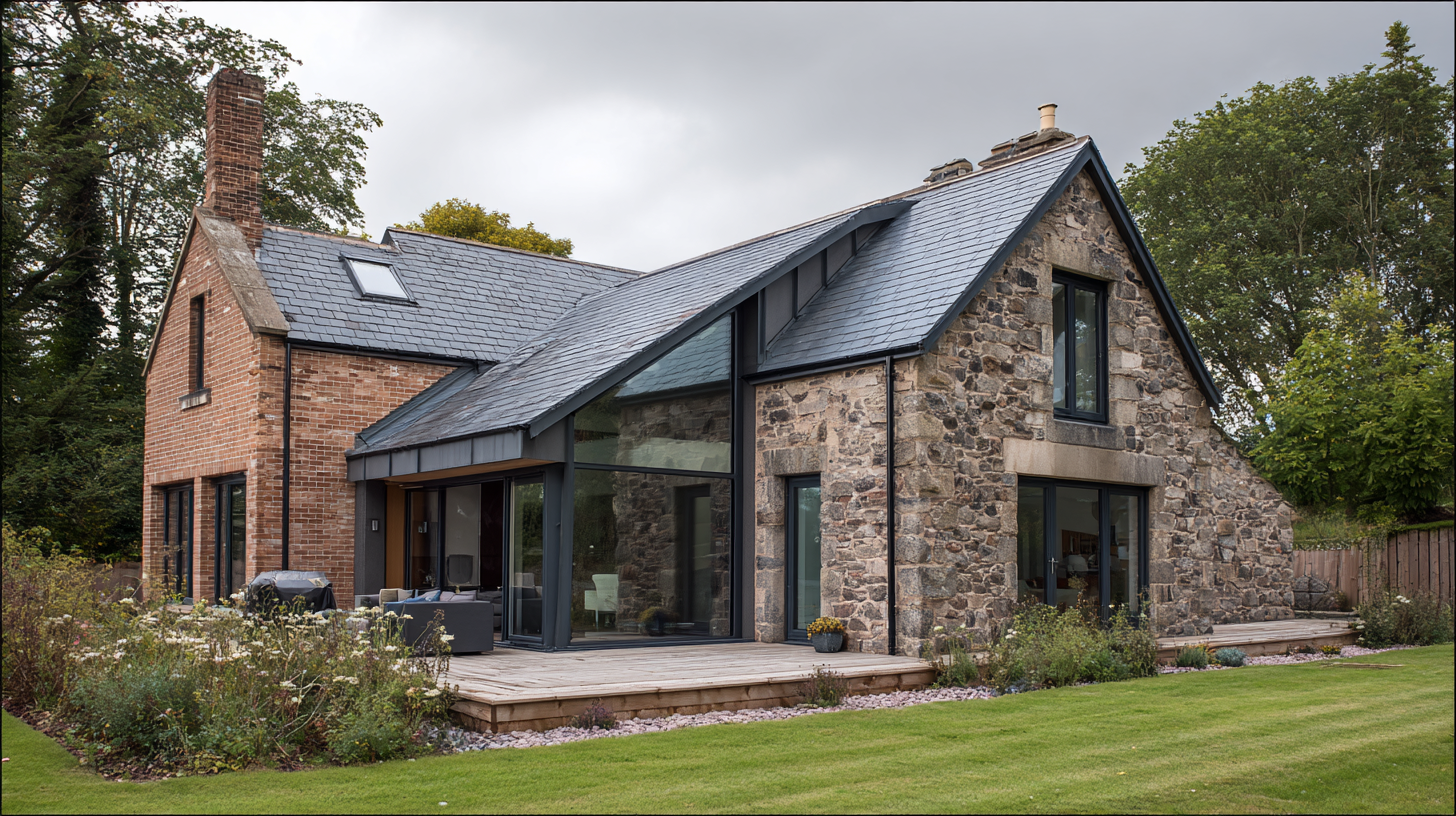
Stone veneer offers a wider textural range: split-face, honed, polished, layered, crystalline, veined. Colour runs from pure white through greys, greens, golds, coppers, and blacks — browse the full range to see the variety. Stone can be dramatic or subtle, contemporary or heritage, and it's at home in contexts where brick would look out of place — a Highland lodge, a converted steading, a modern coastal home.
For architects: Stone veneer generally offers more latitude for distinctive design expression. Brick slips work best when brick is the right design language for the project.
8. Sustainability
Brick slips: Kiln-fired clay manufacturing is energy-intensive. Transport carbon depends on origin (UK-manufactured slips have lower transport emissions than imported alternatives). Clay is a natural material that can theoretically be recycled, though in practice most demolition brick goes to aggregate.
Natural stone veneer: Quarrying has an environmental impact, but natural stone requires minimal processing compared to manufactured products — no kiln, no cement, no pigments. Transport emissions depend on origin. Stone has a long documented history of reclamation and reuse in Scottish building traditions — Historic Environment Scotland documents this heritage extensively.
Ultra-thin stone veneer: The composite backing adds a processing step, but the dramatically reduced material volume (1–3mm vs 15–30mm) means less quarried stone per square metre. The weight reduction also reduces transport emissions per m² of installed product.
Neither material is a clear sustainability winner. Both are better than polymer-based alternatives. The most sustainable choice is often the one that lasts longest without replacement — which, for both materials, comes down to installation quality.
---
Decision Framework: When to Choose Which
Choose brick slips when:
- The design intent is a brick aesthetic — coursed, uniform, geometric
- The project is a housing development matching surrounding brickwork
- You need large-area exterior coverage on a solid substrate
- Budget is tight and the substrate is already load-bearing
- Planning conditions specify brick as the required material
Choose stone veneer when:
- The design calls for texture, depth, and natural variation
- The project is in a region where stone is the traditional building material
- The substrate is lightweight (timber frame, plasterboard, SIPs) — ultra-thin stone may be the only option
- Fire rating documentation is critical (all natural stone is A1)
- The building needs to connect to Scotland's architectural heritage
- The application is interior (feature walls, bathrooms, fireplaces) where stone's textural qualities are most appreciated
Either material works when:
- The substrate is solid masonry or concrete block
- The budget allows both options
- Fire performance exceeds minimum requirements regardless
- Long-term durability is the priority (both last 30+ years when well installed)
---
The Scotland Perspective
Scotland builds with stone. From Aberdeen's granite to Edinburgh's sandstone, from Angus farmsteads to Highland lodges — the architectural language of Scotland is stone, not brick. Brick has its place, particularly in post-war housing and industrial buildings, but stone is the material that defines Scotland's built character.
That's not a reason to dismiss brick slips — if the design calls for brick, brick slips are a practical and cost-effective solution. But for projects where the finish should reflect Scottish building tradition, where the material needs to look like it belongs against a backdrop of sandstone terraces or granite walls, stone veneer carries an authenticity that brick slips don't.
The choice is yours. Both materials are capable, durable, and well-suited to Scottish conditions when correctly specified. The question isn't which is better — it's which is right for this project, on this substrate, in this context.
If you're specifying for a Scottish project and want to understand which stone products work for your application, we can help. Order samples to see products in your own daylight, or open a trade account for access to trade pricing and technical support.
Request Samples | View Products | Open Trade Account
---
Sources: Industry data from MyBuilder, Devis Architecture, Real Brick Cladding, Real Stone Cladding, Homebuilding & Renovating, Airtasker. Fire classification data from BS EN 13501-1, Scottish Government Building Standards Technical Handbook 2022. Sustainability and heritage context from British Geological Survey and Historic Environment Scotland. Product-specific data from Masowa Stone product catalogue (November 2025). All data accessed 2026.